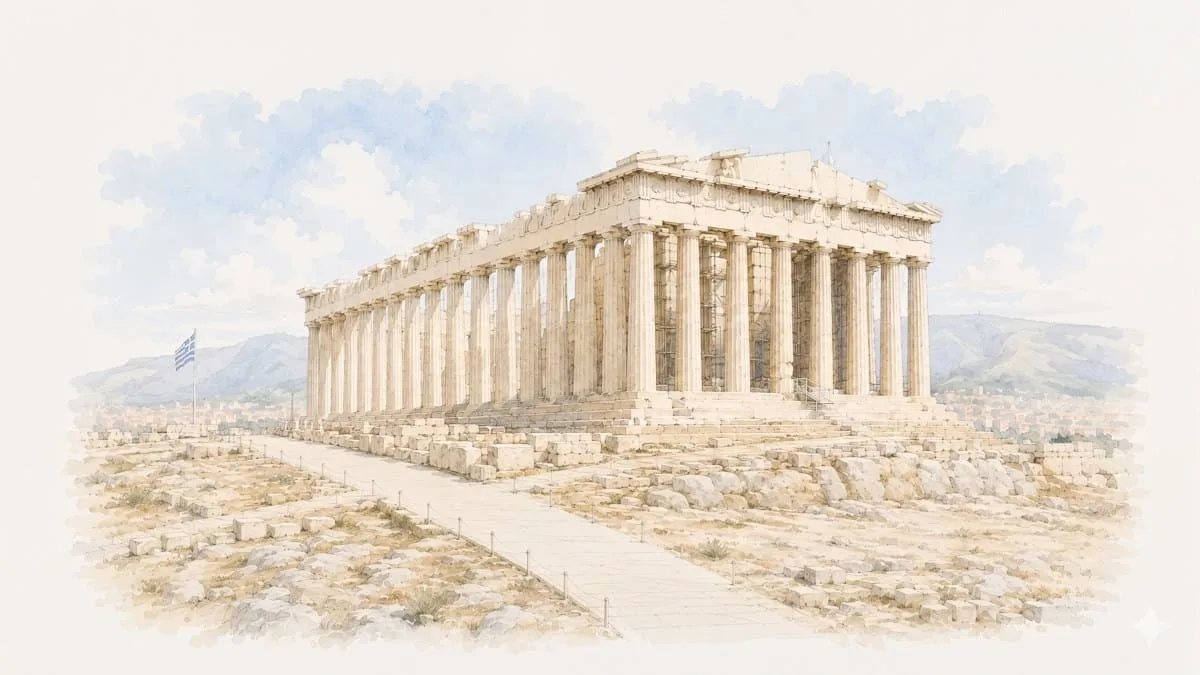
Historical note: The siege of the Acropolis took place between 23 and 29 September 1687. The Venetian Captain-General Francesco Morosini positioned his artillery on Philopappou Hill. The Ottomans had stored around 700 barrels of gunpowder inside the Parthenon. At 7 PM on 26 September, a shell struck the powder magazine. The explosion killed over 300 people. Morosini called the shot "fortunato colpo", the lucky shot.
Parthenon · Modern Period · 26 September 1687, 7 PM
The Lucky Shot
Story teaser
For two thousand years the Parthenon endured, until one shell found the powder hidden inside.
3 min read
The Lucky Shot
0:000:00
Also at this location
While you are standing here, look around. A Roman magnate builds a theatre where love, grief, and suspicion still share the stage.
25 cinematic stories written by a historian, heard in the exact places where they happened.
Tap any marker to see nearby stories
Story
The Lucky Shot
Parthenon · Modern
For two thousand years, the Parthenon had stood almost intact.
It was built as an answer to the Persians, who had burned down the temple that stood here before. The Parthenon itself never faced them, but it faced everything that came after. The Romans. The Crusaders. The Ottomans. It became a church, then a mosque. The building changed hands and changed purpose, but its structure stood.
That evening, there were 700 barrels of gunpowder inside it.
The Ottomans had chosen the Parthenon as an ammunition store, perhaps believing no one would dare to bombard it. But they did not know Morosini. A military commander who had already taken the entire Peloponnese. A man whom Venice would make Doge after this victory. He did not care what the Parthenon was. He cared what was inside it.
The Venetian commander had positioned his artillery on Philopappou Hill. From there, his guns had been firing for three days.
At 7 PM on 26 September 1687, a single shell pierced the marble roof.
The explosion was heard as far away as Piraeus.
More than three hundred people were killed instantly. Not only soldiers. Families had shut themselves inside, women, children. The place they believed untouchable became, that night, the deadliest in the city.
The central chamber collapsed. The columns fell. Pheidias's frieze, 160 metres of marble, carved over fifteen years, was reduced to fragments in minutes.
Morosini called the shot "fortunato colpo." But Konigsmark, the Swedish field marshal who commanded the land army, saw it differently. Anna Akerhielm, companion to his wife and an eyewitness, wrote in one of the earliest surviving accounts how heavily it weighed on him to destroy a temple so ancient it seemed eternal.
One rejoiced. The other mourned.
Before the Venetians left, Morosini tried to remove statues from the western pediment. Poseidon and the horses of Athena fell and shattered on the ground as they were being lowered.
The Parthenon was now a ruin.
Today, as you stand here
What you see is not a ruin slowly worn down by time. The Parthenon stood almost intact until that night. What you see is the result of a single evening.
Two thousand years of endurance. One shell. Two minutes.

“I taught history for 17 years. I learned that no one remembers dates - they remember moments. Those are what I write.”
Georgia Michalatou
Historian and educator - Ionian University, Department of History and Digital Humanities
Full collection
24 more stories like this one. All of Athens, differently heard.